CSW 2026
Computer Science Workshop 2026
7th Edition
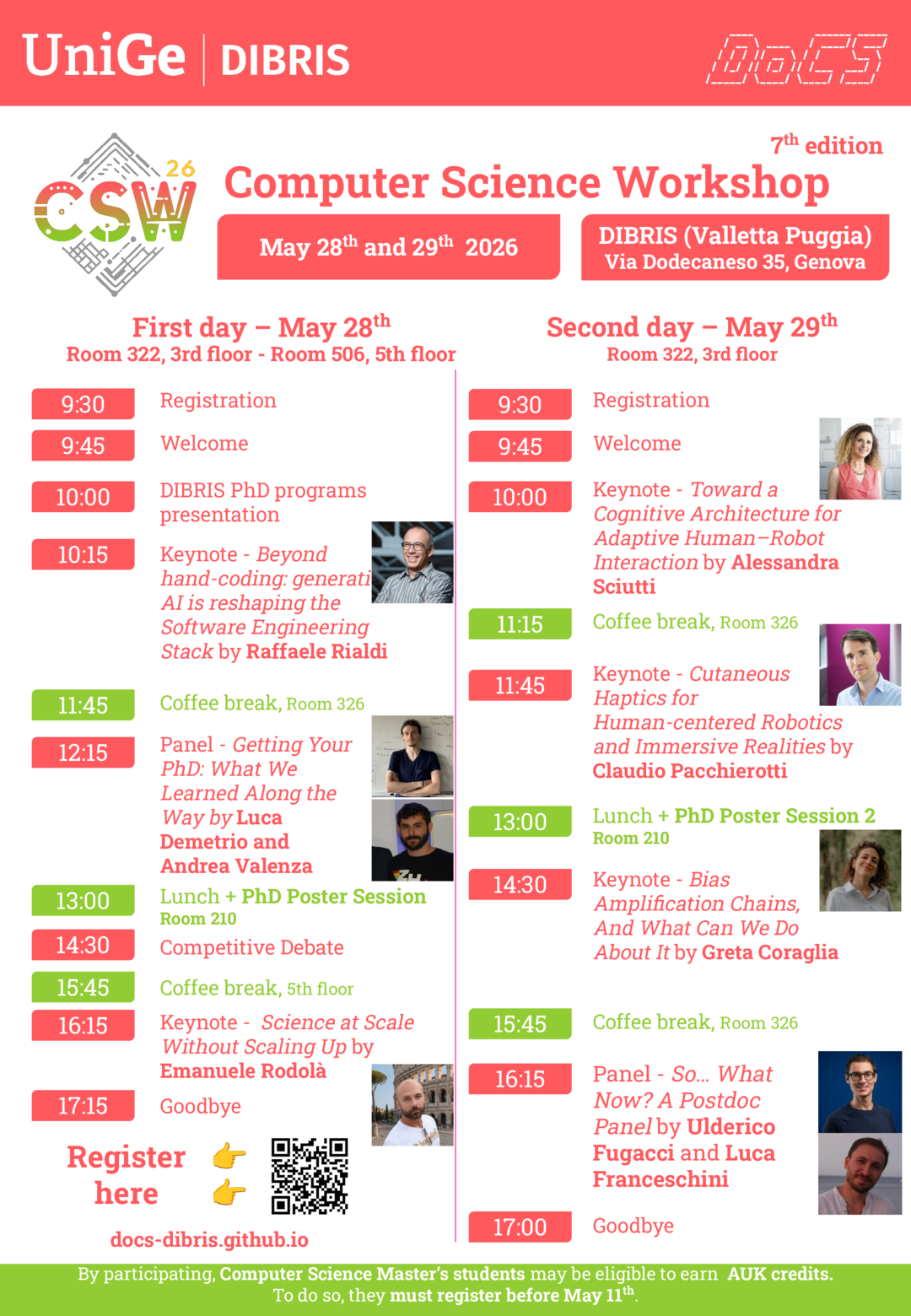
May 28th and 29th, 2026
DIBRIS (Valletta Puggia), Università di GenovaVia Dodecaneso 35, Genoa
with the contribution of the University of Genoa
Flyer
Motivation and goals
The DoCS group is pleased to announce the seventh edition of the Computer Science Workshop (CSW), taking place May 28–29 at the Valletta Puggia building (DIBRIS department, University of Genoa).
Computer Science evolves rapidly, driven by innovation and interdisciplinary challenges. The DIBRIS department conducts research across Virtual and Augmented Reality, Multi-Agent Systems, Data Management, Geometric Modeling, Cybersecurity, Machine Learning, Programming Languages, Logic, Computer Vision, Software Engineering, and Artificial Intelligence.
The annual Workshop brings our community together to share ideas, present research, and build collaborations. This edition maintains last year’s successful two-day format while adding interactive sessions alongside keynote talks, fostering interaction and engagement for all participants.
The Workshop offers students access to cutting-edge research and researchers the chance to explore cross-disciplinary connections. Building on last year’s success, this year also targets Master’s students to strengthen their engagement with departmental research. Students seeking AUK credits for attendance should consult the dedicated section.
Activities
This year’s edition will feature activities delivered by distinguished speakers:
- Emanuele Rodolà, Sapienza, University of Rome
- Claudio Pacchierotti, Centre National de la Recherche Scientifique, Rennes
- Alessandra Sciutti, Italian Institute of Technology, Genoa
- Raffaele Rialdi, Vevy Europe, DotNetLiguria, Genoa
- Greta Coraglia, MIRAI, Milan
- Luca Demetrio, University of Genoa
- Luca Franceschini, Esaote, Genoa
- Ulderico Fugacci, National Research Council, Genoa
- Andrea Valenza, Prima Assicurazioni, Genoa
Additional information about the speakers and their activities can be found in the program section.
PhD Poster Session
During lunches of the event, Computer Science and Systems Engineering PhD students will have two poster sessions to present their work to participants and speakers. The poster sessions will be held in room 210, 2nd floor.
Posters will be set up in the room during the morning. Our staff will handle the setup of those printed by us. If you plan to print your poster in some other way, please be sure to hang it in the designated area within the lunch break.
You can find the official CSW poster template here.
Please submit your poster by emailing it to either Matteo or Andrea no later than May 22. This will allow us to handle the printing and ensure your poster is set up and ready for your session. A few days before the event, we will share with you which poster session you have been assigned to.
If you are not able to submit your poster by the deadline, or if you prefer to just print it yourself, you are welcome to do so, but please make sure to hang it in the designated area within the lunch break. We also ask you to please let us know if you will be printing the poster yourself, so that we can plan accordingly.
Reimbursement for printing costs will be guaranteed for expenses up to 20 euros, upon presentation of the receipt, stating clearly that you paid for printing an A0 poster, so please be sure to ask for it to the printing service you use.
Competitive Debate
The afternoon of the first day will feature the final competitive debate session of the AUK Part 1 (Soft Skills). The debate teams will be composed of Master’s students in Computer Science who have registered for the acquisition of AUK credits. The debate will be evaluated by a jury composed of a PhD student, a professor, and a researcher, who will assess the clarity, coherence, and depth of the arguments presented.
Participants will be added to a dedicated Microsoft Teams channel, where all logistical information, preparation materials, and the official debate protocol (rules) will be shared. An introduction to debating will be provided on the 18th of May, 2:30 PM. During that meeting, we will also provide the debate topica and some initial material on that, although students will be encouraged to look for their own.
Program
This year’s edition of the Computer Science Workshop will take place over the course of two full days: Thursday, May 28, and Friday, May 29.
A variety of sessions and formats will follow one another throughout the event, offering opportunities for in-depth discussion, exchange of ideas, and discovery. The full schedule is outlined below, with details provided for each day.
— Thursday, May 28 —
Registration
- Start time: 9:30 AM
- Duration: 30 minutes
- Location: Room 322 (corridor), 3rd floor
A registration booth will be arranged at the 3rd floor. There will be a registration desk where you can pick up your badge.
Welcome
- Start time: 9:45 AM
- Duration: 15 minutes
- Location: Room 322, 3rd floor
Welcome and introduction to the CSW. The DoCS team will also present themselves and their activities.
DIBRIS PhD programs presentation
- Start time: 10:00 AM
- Duration: 15 minutes
- Location: Room 322, 3rd floor
Prof. Giorgio Delzanno will present the DIBRIS PhD programs, with a particular focus on the Computer Science and Systems Engineering PhD one, and the opportunities it offers to students.
Keynote - Beyond hand-coding: generative AI is reshaping the Software Engineering Stack by Raffaele Rialdi
- Start time: 10:15 AM
- Duration: 1 hour + 30 minutes for open discussion
- Location: Room 322, 3rd floor
Abstract
In 2026, generative AI and agentic architectures have brought software development to a qualitatively new level, enabling the transformation of natural language specifications into working code while agentic pipelines independently review correctness, validate logic, and surface security vulnerabilities. While this remains only an initial step toward automation across several other disciplines, the real challenge is now to figure out how humans can lead the orchestration role rather than vibe functionalities as if rubbing an Aladdin lamp.
Raffaele’s bio
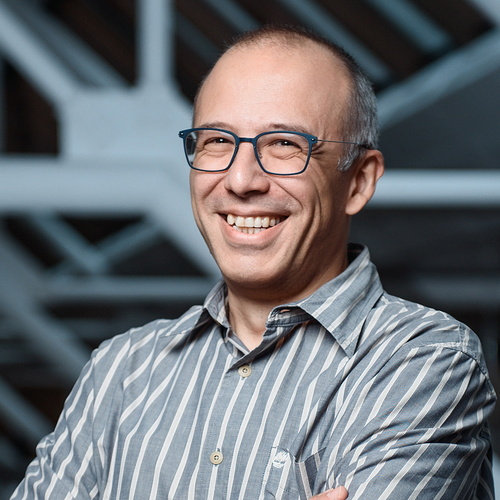 Raffaele Rialdi holds a degree in Electronic Engineering, is registered with the Genoa Order of Engineers, and is a member of its ICT commission. He has been professionally involved in software design and development since 1987. He has been a Microsoft MVP since 2003 and participates in weekly meetings with Microsoft teams in Redmond, working on development technologies with access to the Windows source code. He is also the president of the DotNetLiguria community, through which he organizes free events focused on software development. He currently works as a consultant, conference speaker, course instructor, and leads a development team at Vevy Europe, where he serves as Senior Software Architect and Developer.
Coffee Break (catered)
- Start time: 11:45 AM
- Duration: 30 minutes
- Location: Room 326, 3rd floor
Panel - Getting Your PhD: What We Learned Along the Way by Luca Demetrio and Andrea Valenza
- Start time: 12:15 PM
- Duration: 45 minutes
- Location: Room 322, 3rd floor
After the panel and before the lunch break, PhD students having a poster in Poster Session 1 will give a flash presentation of their work, to encourage participants to attend the poster session and interact with them during lunch.
Abstract
This panel features two alumni of our department, Luca and Andrea, who will share their doctoral experiences and insights. They will discuss their motivations for pursuing a PhD, challenges encountered during their studies, and whether they would make the same choice again. Luca has pursued a career in academia, while Andrea has transitioned to industry, allowing them to offer contrasting perspectives on how doctoral training has shaped their professional paths. They will also welcome questions, curiosities, and concerns from the audience, providing an interactive opportunity for prospective doctoral students to engage directly with their experiences.
Panelists’ bios
Luca Demetrio
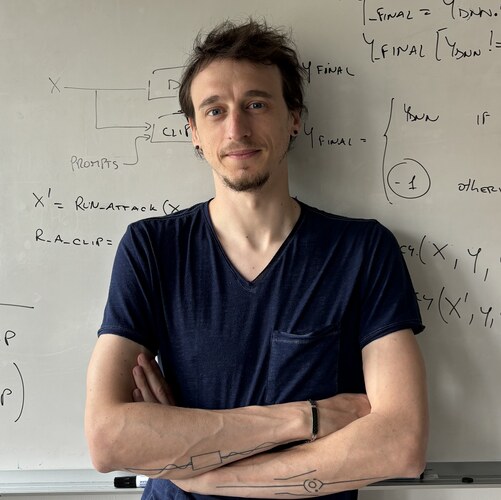 Luca Demetrio is Assistant Professor (tenure-track) at the University of Genoa. During his Ph.D. (concluded in 2021) he produced seminal techniques and software libraries to conduct security evaluations of AI-based Windows anti-malware programs, widely used by the community. He is currently studying the reliability of machine learning in cybersecurity contexts, where deployed AI technologies must be accurate in flagging potential threats, while also being robust against adversarial attacks.
Andrea Valenza
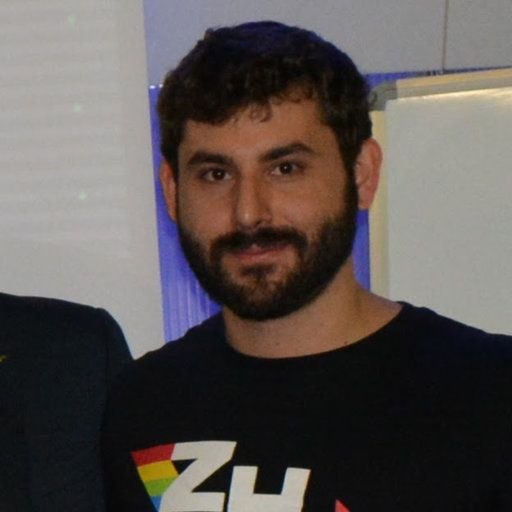 Andrea Valenza is a Security Engineer at Prima Assicurazioni, focused on Agentic AI Security, Application Security, and Incident Response. He previously worked at IMQ Minded Security as a Security Consultant and Trainer, delivering security assessments and training on critical banking applications. He holds a PhD in Computer Security from the University of Genoa (2021), with research on counter-attacking security scanners (notably Metasploit Pro) and bypassing ML-based web application firewalls. He co-founded the ZenHack CTF team.
Lunch (catered) + Poster Session 1
- Start time: 1:00 PM
- Duration: 1 hour and 30 minutes
- Location: Room 210, 2nd floor
You will find the following posters:
| Name | Poster Title |
|---|---|
| Irem Arici | Modeling the Relationship Between Appraisals and Facial Expressions |
| Peiman Ataei | Autonomous Drone-Based Photovoltaic Inspection for Standardized Data Acquisition |
| Abdelmalik Benfadhil | Stochastic Policies for Olfactory Search in POMDPs using Natural Actor-Critic |
| Gabriele Bortolai | Leveraging Smartphone Inertial Data for User Authentication |
| Massimiliano Ciranni | Lose Your Self (LoYS): an adversarial entropy-based unsupervised approach for model debiasing |
| Andrea Gatti | VEsNA: Virtual Environments via Natural language Agents |
| Lorenzo Gerini | Immersive VR for the Assessment of Spatial Skills in Adolescents |
| Andrea Giusto | Dependent type theories for differentiable programming over manifolds |
| Giampiero Granatella | Continuous Talent Intelligence: A DevOps-Inspired Knowledge Graph and RAG Architecture for Real-Time Competency Management |
| Marco Monteverde | Quantifying Impact and Innovation in Scientific Publications: A Structural–Semantic Framework Combining Co-authorship and Research Topics |
| Veronica Pignedoli | FRODO: 3D Classification of Paramagnetic Rim Lesions in Multiple Sclerosis via Asymmetric QSM-FLAIR Modeling |
| Marianna Pizzo | ActivePaws: A Wearable-Controlled Exergame Platform for Pediatric Motor Rehabilitation |
Competitive Debate - TBD
- Start time: 2:30 PM
- Duration: 1 hour and 15 minutes
- Location: Room 506, 5th floor
Master’s students will engage in a competitive debate focused on Topic TBD. Two teams of students will compete, adhering to a specific protocol, each defending distinct positions on a particular motion related to TBD.
The event will be public, allowing the audience to attend and observe the exchange. After the formal debate is over, the audience will have the opportunity to interact with the teams, fostering an engaging environment for discussion and exploration of the defended positions.
Coffee Break (catered)
- Start time: 3:45 PM
- Duration: 30 minutes
- Location: Room 506, 5th floor
Keynote - Science at Scale Without Scaling Up by Emanuele Rodolà
- Start time: 4:15 PM
- Duration: 1 hour
- Location: Room 506, 5th floor
Abstract
Scientific discovery is moving at a pace that is increasingly hard to track. While we have looked to AI to manage this information explosion, current “artificial scientist” models are running into serious technical and ethical barriers. The dominant trend of scaling up has become too expensive and environmentally costly, creating a divide that favors only the most resource-rich institutions. This presentation is going to propose a different path: interoperable machine learning. Instead of building bigger black boxes, we’ll look at how we can repurpose and stitch together existing models. This approach has the potential to make AI more sustainable, democratize research, and ensure that human scientists stay central to the process of creating and verifying knowledge.
Emanuele’s bio
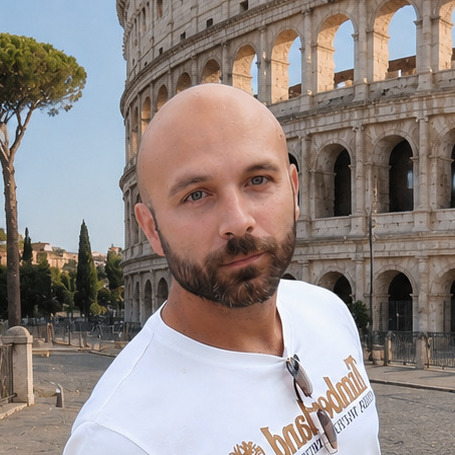 Emanuele Rodolà is a Full Professor of Computer Science at Sapienza University of Rome, where he leads the GLADIA group on AI. His work in this field has been supported by an ERC grant, a FIS grant, and a Google Research Award among others. In the past, he was a postdoctoral researcher at USI Lugano (2016–2017), a Humboldt Fellow at TU Munich (2013–2016), and a JSPS Fellow at the University of Tokyo (2013), in addition to visiting periods at Tel Aviv University, Technion, École Polytechnique, and Stanford. He is a fellow of ELLIS and a fellow of the Young Academy of Europe. Professor Rodolà has received numerous awards for his research and plays an active role in the academic community, serving on program committees and as Area Chair for major conferences in AI and ML. His current research focuses primarily on neural model fusion, representation learning, language models, ML for audio, and multimodal learning, with around 200 publications in these areas. His work has been featured in media outlets including Fortune, Wired, RAI, and Internazionale.
End of Day
- Start time: 5:15 PM
- Duration: 15 minutes
- Location: Room 506, 5th floor
Final remarks and thanks. This is the moment when team roles for Friday’s activity will be announced.
— Friday, May 29 —
Registration
- Start time: 9:30 AM
- Duration: 30 minutes
- Location: Room 322 (corridor), 3rd floor
A registration booth will be arranged at the 3rd floor. There will be a registration desk where you can pick up your badge.
Welcome
- Start time: 9:45 AM
- Duration: 15 minutes
- Location: Room 322, 3rd floor
Welcome and introduction to the second day. The DoCS team will also present themselves and their activities.
Keynote - Toward a Cognitive Architecture for Adaptive Human–Robot Interaction by Alessandra Sciutti
- Start time: 10:00 AM
- Duration: 1 hour and 15 minutes
- Location: Room 322, 3rd floor
Abstract
Effective human–robot collaboration requires more than high task performance; it depends on alignment between human and robotic cognition. Human interaction relies heavily on non-verbal cues such as gaze, motion dynamics, and timing to support anticipation and coordination. Drawing on these principles, robotic systems can be designed to perceive and express meaning in ways that are compatible with human expectations. Embedding embodied interaction mechanisms within cognitive architectures grounded in memory and motivation enables robots to adapt to different partners and contexts over time. Bio-inspired approaches that integrate perception, action, memory, motivation, and prospection support learning from experience, anticipating others’ behavior, and generating socially meaningful responses. This perspective moves human–robot interaction beyond reactive control toward adaptive, cognitively grounded collaboration, contributing to robots that can co-adapt with humans through shared experience and operate as intuitive and trustworthy partners.
Alessandra’s bio
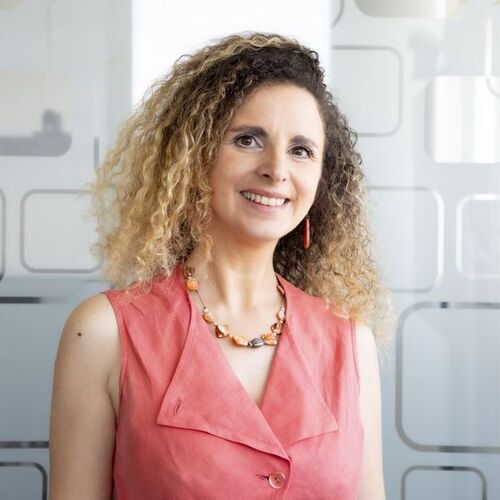 Alessandra Sciutti is a Senior Tenure Track Researcher and head of the CONTACT (COgNiTive Architecture for Collaborative Technologies) Unit of the Italian Institute of Technology (IIT). She received her B.S. and M.S. degrees in Bioengineering and her Ph.D. in Humanoid Technologies from the University of Genova in 2010. After two research periods in the USA and Japan, in 2018, she was awarded the ERC Starting Grant wHiSPER (www.whisperproject.eu), focused on the investigation of joint perception between humans and robots. She has published more than 100 papers and abstracts in international journals and conferences, coordinates the ERC POC Project ARIEL (Assessing Children Manipulation and Exploration Skills), and has participated in the coordination of the CODEFROR European IRSES project (https://www.codefror.eu/). She is currently Chief Editor of the HRI Section of Frontiers in Robotics and AI and Associate Editor for several journals, including the International Journal of Social Robotics and Cognitive System Research. She is an ELLIS scholar and the corresponding co-chair of the IEEE RAS Technical Committee for Cognitive Robotics. Her research aims to investigate the sensory and motor mechanisms underlying mutual understanding in human-human and human-robot interaction.
Coffee Break (catered)
- Start time: 11:15 AM
- Duration: 30 minutes
- Location: Room 326, 3rd floor
Keynote - Cutaneous Haptics for Human-centered Robotics and Immersive Realities by Claudio Pacchierotti
- Start time: 11:45 AM
- Duration: 1 hour and 15 minutes
- Location: Room 322, 3rd floor
Abstract
As robotics advances into more integrated human-centered applications, haptic feedback plays a crucial role in connecting humans and robots seamlessly. While force feedback has traditionally played a crucial role, this presentation explores the untapped potential of cutaneous haptics to create more natural, richer, and safer interactions in human-centered robotics. Dr. Pacchierotti will share his contributions to this field, discussing the role of cutaneous and kinesthetic haptics in human-machine interaction, presenting the design of innovative cutaneous haptic interfaces and rendering techniques, along with their application in human-centered robotics and immersive environments. Emphasizing a holistic and multi-modal approach to haptic feedback, this talk aims to inspire researchers and engineers to explore cutaneous haptics for developing the next generation of sensory human-robot interfaces. The presentation concludes by addressing the scientific and technological challenges in this evolving field.
Claudio’s bio
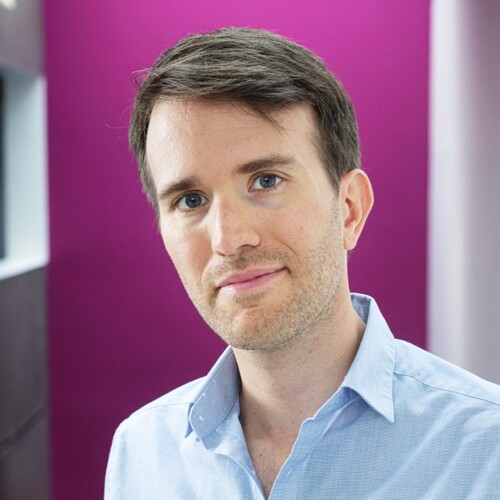 Claudio Pacchierotti is a tenured researcher at CNRS-IRISA in Rennes, France, since 2016. He was previously a postdoctoral researcher at the Italian Institute of Technology, Genova, Italy. Pacchierotti earned his PhD at the University of Siena in 2014. He was Visiting Researcher at the University of Pennsylvania in 2014, at the University of Padua in 2013, at the University of Twente in 2014, at the Sapienza University of Rome in 2022, and at the University of Siena in 2026. Pacchierotti received the 2014 EuroHaptics Best PhD Thesis Award and the 2022 CNRS Bronze Medal. He currently serves as Associate Vice President of the IEEE RAS Technical Activities Board (TAB). He is also Co-Chair of the IEEE Technical Committee on Telerobotics, Secretary of the Eurohaptics Society, and Associate Editor for IEEE Trans. Haptics, IEEE Trans. Robotics, and the Intl. J. Robotics Research.
Lunch (catered) + Poster Session 2
- Start time: 1:00 PM
- Duration: 1 hour and 30 minutes
- Location: Room 210, 2nd floor
You will find the following posters:
| Name | Poster Title |
|---|---|
| Sofia Agostoni | Automatic regularisation approaches for 2D/3D Image Scanning Microscopy (ISM) |
| Christian Daniele | Deep equilibrium models for Poisson inverse problems via mirror descent |
| Zahra Daoui | VEsNA with Region-Agnostic Reinforcement Learning for Interpretable BDI Navigation |
| Andrea De Filippis | Semi-Immersive Virtual Reality System for Rehabilitation in Rett Syndrome |
| Roberto Di Via | CDPM-Align: Multi-Scale Guidance-Aligned Diffusion Pretraining for Robust Few-Shot Anatomical Landmark Detection |
| Alek Fröhlich, Daniel Rodrigues Perazzo | Spectral Representation Learning for Conditional Independence Testing |
| Andrea Marchi | Finite State Controllers for Olfactory Navigation |
| Matteo Martini | Avatar Exposure and Strategic Coordination in Virtual Reality - Recycling in Positano |
| Monica Parodi | Context-Aware Computing and Precise GNSS for the Autonomy of Fragile Individuals |
| Mattia Roccatello | Chromatin Signal Detection and Reconstruction techniques for SMLM Point Cloud Data |
| Arnaud Ruymaekers | Comparing Model-Based Reinforcement Learning techniques for Olfactory Navigation |
| Gabriele Romano | Gathering Children's Affective Data through Embodied Technologies: Highs and Lows |
| Ilaria Stanzani | Sailing the Research Ocean: A Transparent Pipeline for Exploring NSF grants through Keyword-Based Visual Analytics |
| Giordano Vitale | Kernel methods through the sky: flying above the Falkon |
Keynote - Bias Amplification Chains, And What Can We Do About It by Greta Coraglia
- Start time: 2:30 PM
- Duration: 1 hour and 15 minutes
- Location: Room 322, 3rd floor
After the keynote and before the lunch break, PhD students having a poster in Poster Session 2 will give a flash presentation of their work, to encourage participants to attend the poster session and interact with them during lunch.
Abstract
We know that ML systems don’t just reflect societal bias – they amplify it. What is less clear is where in the pipeline this happens, by how much, and what to do about it. This talk introduces the notion of Bias Amplification Chains, a framework grounded in formal logical methods that quantifies amplification at each stage, from data sampling to model output, and illustrates it across several high-stakes domains including credit scoring, HR decision-making, and fraud detection.
Greta’s bio
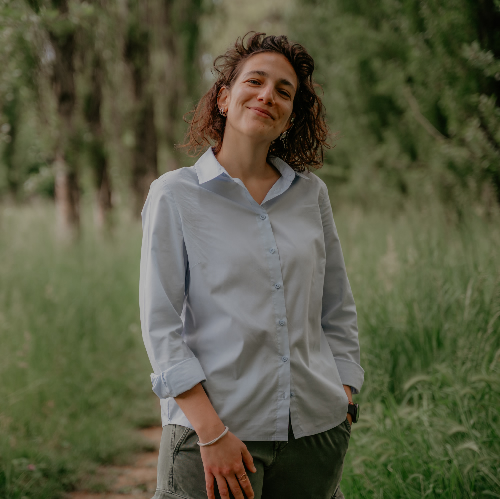 Greta Coraglia is a mathematician specialising in category theory, type theory, and theoretical computer science, with a focus on how compositionality and formal logical methods can make AI systems more transparent and accountable. She co-founded MIRAI, a responsible AI spinoff of the University of Milan, where she leads R\&D on algorithmic fairness and bias detection. Her work bridges foundational research and applied engineering, spanning ML fairness, generative AI evaluation, and the development of logic-based tools for AI auditing. She holds a PhD in Mathematics from the University of Genova and has previously been a postdoc at the LUCI Lab, University of Milan.
Coffee Break (catered)
- Start time: 3:45 PM
- Duration: 30 minutes
- Location: Room 326, 3rd floor
Panel - So… What Now? A Postdoc Panel by Ulderico Fugacci, Luca Franceschini and Laura Di Rocco
- Start time: 4:15 PM
- Duration: 45 minutes
- Location: Room 322, 3rd floor
Abstract
This panel brings together Ulderico, Luca and Laura to discuss the critical transition from doctoral studies to the next career stage. With two panelist continuing in research and one moving into industry, they offer complementary perspectives on navigating the postdoctoral phase and beyond. They will explore key questions: how do you choose the right path after a PhD, whether in research or industry? What skills and experiences matter most for different careers? How do you make informed decisions about your professional future? Through their contrasting trajectories panning research careers in Italy and abroad and transitions into industry, the panelists will provide practical guidance on evaluating opportunities, building networks, and planning a successful transition. Aimed at PhD students facing these pivotal decisions, this interactive session invites questions and discussion to help you chart your own path forward.
Panelists’ bios
Ulderico Fugacci
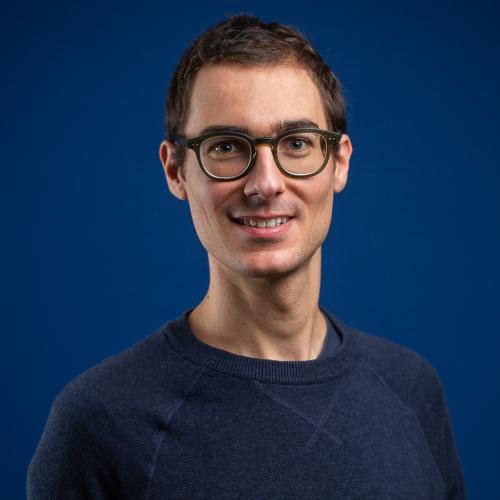 Ulderico Fugacci is a researcher at the Institute for Applied Mathematics and Information Technologies “Enrico Magenes” (IMATI) of the National Research Council (CNR), Italy. He earned his Master’s Degree in Mathematics from the University of Genova in 2012 and a Ph.D. in Computer Science from the same university in 2016, under the supervision of Prof. Leila De Floriani and Prof. Maria Evelina Rossi. Following his Ph.D., he held several postdoctoral positions, including at the University of Maryland, the University of Kaiserslautern, Graz University of Technology, and the Polytechnic University of Torino. His research focuses on Topological Data Analysis, at the intersection of applied mathematics, computer science, and data analysis.
Luca Franceschini
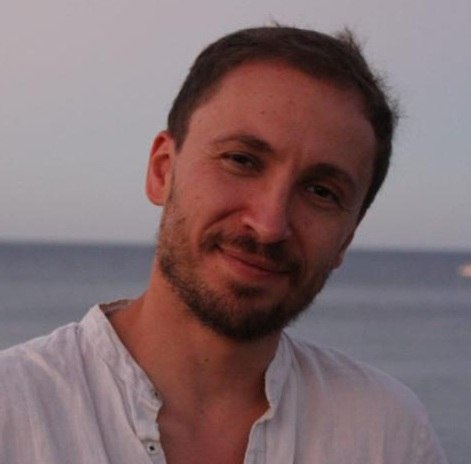 Luca Franceschini is currently a Software Engineer at Esaote, a medical diagnostic systems manufacturer, working in the ultrasound imaging R&D department. He previously worked as a software development consultant, and contributed to the early stage of an agritech startup. Luca completed his PhD in Computer Science at the University of Genoa in 2021, focusing on programming languages and software analysis and verification. In his thesis he proposed and implemented RML, a system agnostic domain specific language for runtime monitoring and verification.
Laura Di Rocco
 Laura Di Rocco is currently the Clinical Data Platform Manager at Gather Health. She previously worked at Bayer in Berlin for over four years in progressively senior roles, including Master Data Manager & Knowledge Graph Expert and Lead Knowledge Engineer, and held a Data Engineering Manager position at Intapp. Prior to her industry career, she was a Postdoctoral Researcher at Northeastern University in Boston. Laura completed her PhD in Computer Science at the University of Genoa in 2019. Her expertise lies in databases, data integration, and knowledge graphs.
End of Day
- Start time: 5:00 PM
- Duration: 15 minutes
- Location: Room 322, 3rd floor
Final remarks and thanks.
Additional information
Participation is free of charge and open to everyone, but registration is required. You can register by clicking on the button under the CSW logo at the top of the page, or on this link.
Lunch and coffee breaks will be offered to all participants.
Additional Useful Knowledge (AUK) credits for Master Students
As for past year’s edition, this edition has also been designed with a special focus on Master’s students, with the goal of bringing them closer to the world of research—both in general and with particular attention to the work carried out by the department’s research groups, faculty members, and PhD students.
To this end, students attending the DSE Curriculum will be eligible to receive AUK credist. In particular
- AUK Part 1 credits (Soft Skills) for participating to the competitive debate. In order to obtain the credits, you must register on the dedicated form on the AUK Aulaweb module in addition to the regular CSW registration.
- AUK Part 2 credits (Scientific Activity) for participating in the event. Students will be required to demonstrate their attendance, and credits will be awarded only to those who attend all activities on both days.
After the event, eligible students will be notified regarding the proper registration of the acquired credits.
In case of any doubt or question regarding the AUK credits, please do not hesitate to contact the professors of the AUK committee.